-
Your shopping cart is empty!
MENU
Your shopping cart is empty!
 New
-62%
 -63%
 -59%
 -63%
 -61%
 -61%
 -60%
 -62%
 -62%
 -60%
 -63%
 -59%
 -59%
 -64%
 -59%
 -64%
 -64%
 -61%
 -64%
 -62%
 -61%
 -62%
 -64%
 -62%
 -62%
 -64%
 -62%
 -62%
 -62%
 -61%
 -61%
 -62%
 -59%
 -61%
 -62%
 -64%
 -61%
 -62%
 -62%
 -61%
 -59%
 -64%
 -62%
 -61%
Golden Goose sneakers are recognized for their distressed finish, Italian construction, and distinctive details across styles such as Superstar, Francy, Mid Star, Slide, Running, and V-Star. Because the worn appearance is part of the design, authentication requires more than judging whether the leather looks aged or the sole appears scuffed.
A serial number, style code, or internal label can provide useful evidence, but it should never be treated as a complete guarantee. Genuine pairs may have different label formats depending on their production period, model, and market. Counterfeiters can also copy codes from authentic shoes and print them on imitation products.
The most reliable approach combines number verification with inspection of the box, construction, materials, logos, stitching, packaging, and seller information. This is especially important when an outlet listing or heavily reduced price seems unusually attractive.
Golden Goose sneakers may display identifying information inside the shoe, on a label beneath the tongue, on the packaging, or through a QR-style tag on some newer releases. The information can include a model reference, size, manufacturing details, batch information, or a product code. Terminology is not always consistent, so a label described as a “serial number” may actually be a style or production reference.
The code can help establish whether the shoe belongs to the claimed model and whether the size and colorway are plausible. It can also reveal inconsistencies. For example, a label naming a leather Superstar should not be paired with packaging that describes a technical-fabric Running model.
There is no dependable public database that allows every shopper to enter a Golden Goose number and receive a definitive authenticity result. A valid-looking sequence is therefore supporting evidence rather than proof. Treat the number as one part of a broader authentication process.
Begin with clear photographs of both sneakers, the inside labels, the soles, the insoles if removable, the box label, and any attached tags. Avoid relying on a single close-up because placement and printing quality are easier to evaluate when the surrounding construction is visible.
Look inside the tongue or collar first. Depending on the model, the label may show the size, country of manufacture, material information, and a reference associated with the design. Check whether the print is sharp, evenly aligned, and firmly attached. Blurred characters, uneven spacing, spelling errors, or a label that appears freshly glued onto an aged shoe deserve additional scrutiny.
Inspect the packaging as well. Box stickers should be consistent with the pair’s model, color, size, and barcode information. A box from a different style is not automatically evidence of counterfeit goods because retailers sometimes replace damaged packaging, but the seller should be able to explain the mismatch clearly.
Compare the identifying information on the left and right sneakers. A pair can have shared model information while still showing size or production details that make sense for both shoes. A completely different code on one shoe is a serious warning, particularly when the labels appear to come from different printing batches.
Next, compare the shoe labels with the box sticker and purchase documentation. The model name, reference, size, and color description should form a coherent set. Minor formatting differences can occur between international packaging and retail systems, so focus on contradictions rather than demanding identical typography everywhere.
Use the following guide to weigh common findings:
| Checkpoint | Reassuring sign | Warning sign |
|---|---|---|
| Inner label | Crisp print, secure attachment, logical information | Crooked label, faded text, misspellings |
| Pair consistency | Left and right shoes belong to the same model and size run | Unrelated codes or visibly different labels |
| Box sticker | Model, size, and color correspond with the sneakers | Sticker describes another style or size |
| QR or barcode | Scan leads to a relevant brand or retail record when applicable | Broken, generic, or unrelated destination |
| Product design | Code agrees with the visible materials and silhouette | Code claims one model while the shoe is another |
| Seller evidence | Dated receipt and detailed photos are available | Stock images and vague provenance |
A barcode or QR code should not be accepted as a digital certificate by itself. Some codes identify inventory or redirect to a general website, while counterfeit products may carry copied or nonfunctional marks. The destination, surrounding label, and physical pair must all agree.
Serial number verification becomes much stronger when the physical shoe supports the same story. Golden Goose designs often use premium leather, suede, glitter panels, technical fabric, rubber soles, and deliberately distressed finishes. Examine whether the materials feel substantial and whether the transitions between panels are clean.
Pay close attention to the star, heel tab, tongue, laces, and outsole. Genuine details tend to have controlled proportions even when the shoe looks intentionally worn. Uneven star placement, rough adhesive, excess glue, thin synthetic material, or a sole that feels unusually light can indicate a replica.
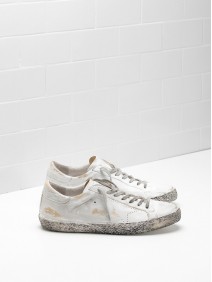
The distressed treatment deserves special attention. Authentic aging usually appears integrated into the design, with variation around the toe, heel, and sole. Artificial distressing may look repetitive, painted on, or excessively harsh. A pair that is too clean is not necessarily fake, and an extremely battered pair is not necessarily authentic; the pattern and quality matter more than the amount of wear.
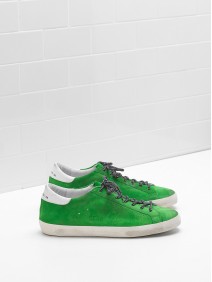
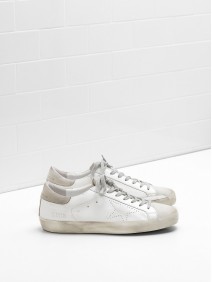
The silhouette should match the claimed model. A Superstar has a different profile from a Francy high-top, Mid Star, or Running sneaker. If a product reference appears credible but the shape, panel arrangement, or sole construction does not match catalog photographs from the same release, pause before buying.
Price is an important risk indicator, though it is not final proof. Outlet pricing, seasonal clearance, and authorized promotions can reduce the cost of genuine Golden Goose sneakers. A discount becomes more concerning when combined with copied product photos, limited information, pressure to pay outside the platform, or a seller who refuses to provide label images.
Review the listing for precise details about leather, suede, glitter, technical fabric, rubber soles, sizing, and condition. A professional listing should distinguish factory distressing from later wear and should show the exact pair where possible. Generic descriptions that combine several models may conceal a mismatch between the advertised reference and the actual shoes.
When browsing a UK-oriented store or outlet-style website, check shipping terms, returns, contact details, and payment protections before relying on the serial number. A low price should not remove the buyer’s ability to return an item that fails inspection. For shoppers comparing models, a dedicated V-Star sneaker selection can also help establish the expected shape and detailing of a specific style before purchase.
Authenticate the pair in a fixed order rather than making a quick decision based on one attractive feature. Save the listing and seller details before checkout, then compare the received item with the advertised photographs. Photograph the package as it arrives in case a return or payment dispute becomes necessary.
If the code appears genuine but the construction feels wrong, trust the inconsistency and seek an independent assessment. A professional authentication service, experienced luxury sneaker reseller, or retailer with a clear verification policy may be able to compare the pair with known examples. Avoid modifying, wearing, or cleaning the sneakers until the inspection is complete.
Use these safeguards before completing a purchase:
Authenticating Golden Goose sneakers is a process of matching several independent clues. The code helps identify what the pair claims to be; materials and construction show whether that claim is credible; seller documentation explains how the shoes entered the market. Apply all three checks before accepting a discounted listing as a genuine bargain, and keep your photos and purchase records until the pair has been fully verified.